Showing posts with label Marcelo Crivella. Show all posts

Friday, February 24, 2017

Brazilian Carnival in Rio, a City Ruled by a Neo-Pentecostal Mayor


Brazilian Carnival in Rio, a City Ruled by a Neo-Pentecostal Mayor

By Julio Severo
While campaigning last year to become mayor, Marcelo Crivella, a retired neo-Pentecostal bishop, insisted his religion would not get in the way of governing Rio de Janeiro, Brazil’s most famous city.
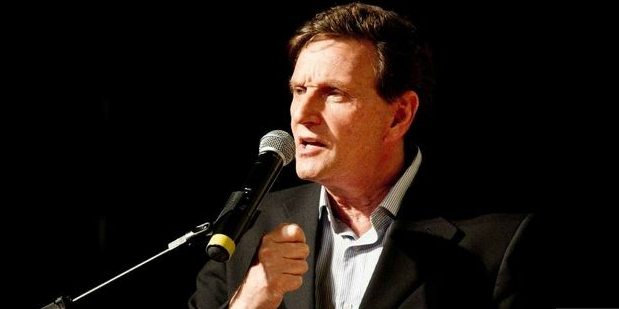
Marcelo Crivella
The former gospel singer and missionary, a high-profile member of the Universal Church of the Kingdom of God (UCKG), captured 59 percent of the vote and took office Jan. 1. But less than two months into his four-year term, Crivella’s promises are about to be tested by Carnival, Rio’s annual weeklong party often marked by heavy drinking and drug use, wild sex, crimes and round-the-clock dancing.
Given Rio’s current economic crisis, it makes no difference if Crivella is neo-Pentecostal, Catholic or an atheist. It is irrational and immoral to invest in Carnival when Rio is unable to pay wages to its public servants.
Traditionally, Brazilian evangelicals, especially Pentecostals, do not take part in Carnival. Yet, UCKG has been an exception in many issues, especially abortion, where its founder, Edir Macedo, has made several pro-abortion statements. Crivella has kept a homosexualist department in his administration headed by Nélio Georgini, a Presbyterian homosexual appointed by him.
When he was running last year, Crivella promised he would not try to alter major city events, such as Carnival or the annual gay parade. This is a sharp contrast with Dr. Geremias Fontes, who was the governor of Rio (1967-1971). The Fontes administration defunded Carnival from tax-money, even though it did not bar private groups from funding it.
Fontes was a Presbyterian who later was baptized in the Holy Spirit and eventually became a minister of an independent charismatic fellowship with a special ministry to help youth involved in drug addiction, one of the many problems plaguing Rio.
Young men and women, with Carnival lifestyles (heavy drinking and drug use, wild sex), came to his fellowship and were delivered, healed, saved and transformed by Jesus Christ.
Even though Brazil is the largest Catholic nation in the world, evangelicals, especially Pentecostals and charismatics, have enjoyed an extraordinary growth for their churches and a growing role in politics.
Twenty-two percent of Brazilians currently identify as evangelical Christians. In 1970 only 5 percent had such identification.
The Evangelical Parliamentary Caucus, representing about a fifth of seats in the Brazilian Congress, has emerged as a political conservative force that was influential in socialist President Dilma Rousseff’s removal last year and pushes for pro-life and pro-family laws.
Crivella is totally supportive of Israel. His first trip, after his election, was to Israel, to thank God. Even though he is not as conservative as Geremias Fontes or other charismatics, in comparison to pro-abortion, homosexualist congressman Jean Wyllys, who represents Rio, he is very conservative.
With information from the Associated Press.
Recommended Reading:

Saturday, November 05, 2016

Rio’s evangelical new mayor to celebrate victory in Israel


Rio’s evangelical new mayor to celebrate victory in Israel

Marcelo Crivella to meet with Netanyahu and Jerusalem Mayor Nir Barkat next week, Brazilian media reports

JTA
Comment by Julio Severo: Mr. Crivella, who is a former bishop of the Universal Church of the Kingdom of God (UCKG), was never able to show a solid stance against anti-“homophobia” bills and he was very close to the former socialist President Dilma Rousseff. And his denomination is shamefully known for being pro-abortion and, as far as prophecies and revelations are concerned, cessationist. I hope Crivella may have changed and be now a “black sheep” in the UCKG. But, despite of weaknesses, he has a good quality: He is pro-Israel. The known conservative website Breitbart reported about Crivella’s intent to celebrate his victory in Israel. Breitbart mentioned a report from the Israeli newspaper Times of Israel, fully reproduced below:
RIO DE JANEIRO — The mayor-elect of Rio de Janeiro, a prominent evangelical leader, reportedly will be going to Israel to celebrate his victory.
Marcelo Crivella, who was elected Sunday, will meet Prime Minister Benjamin Netanyahu and Jerusalem Mayor Nir Barkat next week, several Brazilian media outlets reported, citing the mayor-elect himself as the source. However, the information has not been confirmed by Israeli officials.
“Marcelo Crivella, who has been to Israel nearly 35 times, is a great friend of the Jewish community and the State of Israel,” Israel’s Rio-based honorary consul Osias Wurman, a former president of Rio’s Jewish federation, told JTA. “I hope he will strengthen a lot of the cooperation between Rio and the State of Israel, in particular in the areas of security, culture and technology.”
Brazil’s most influential weekly magazine reported Monday that the Jewish vote from one of Rio’s wealthiest neighborhoods was key in electing Crivella. The massive support could have been a reaction to Crivella’s opponent’s party members, who recently referred to the late Israeli President Shimon Peres as an “ideologue of terrorism” and, a year ago, burned the Israeli flag in public.
Crivella easily beat his far-leftist opponent Marcelo Freixo with 59 percent of the vote in the municipal runoff election in Brazil’s second largest city.
In January, when Brazil rejected Israel’s choice of a former settler leader as ambassador to Brasilia, Crivella said it conveyed a pro-boycott message. The position has since remained vacant.
“Rejecting the ambassador can convey a message that Brazil supports BDS,” Crivella wrote in an op-ed published in the influential Brazilian newspaper Folha de S. Paulo, referring to the anti-Israel Boycott, Divestment and Sanctions movement. “Leaving Israel without an ambassador won’t help anyone.”
Crivella called Dani Dayan “a prepared diplomat selected legitimately by a friendly country. The fact that he defends settlements in the West Bank is a weak motive for such discourtesy and so much political inability.”
In his article, Crivella noted the deep ties between Brazil and Israel, recalling that Brazilian diplomat Oswaldo Aranha presided over the United Nations session that created the State of Israel in 1948.
In November, the senator joined some 1,500 demonstrators at a pro-Israel rally in Rio de Janeiro. Days before, during a major TV show, he had called for “all friends of Israel” to attend the rally.
Crivella is a nephew of Edir Macedo, founder of the Universal Church of the Kingdom of God some 40 years ago. He also has played a pivotal role in the church gathering some 5.2 million followers at 13,000 temples across Brazil and worldwide. The church owns the second-largest TV station in Brazil, as well as a broad conglomerate of newspapers and radio stations.
By assuming the chair of mayor of Rio on Jan. 1, Crivella will interrupt his second eight-year term in the Senate.
Brazil, which has the world’s largest Catholic population — some 65% of its population of 204 million — is home to some 120,000 Jews.
Recommended Reading:

Monday, October 31, 2016

Victory of Marcelo Crivella for Rio Mayor Astonishes Conservatives in Brazil


Victory of Marcelo Crivella for Rio Mayor Astonishes Conservatives in Brazil

By Julio Severo
Being used to the shamefully pro-abortion stances of Bishop Edir Macedo, the founder of the Universal Church of the Kingdom of God (UCKG), it was a big surprise, for me and other Brazilian pro-life leaders, to see the candidate for Rio de Janeiro mayor, Marcelo Crivella, delivering a speech after his election Sunday honoring the constituents who chose him. Crivella is a Macedo’s relative and a former UCKG bishop.
Marcelo Crivella
In a Facebook vídeo, Crivella said that the constituents’ choice of him was a “No” to abortion, a “No” to drug liberation and a “No” to gender ideology. This public acknowledgement was very important, because elected candidates today have no interest in citizens’ concerns. Crivella, even being a moderate socialist, had this concern.
In fact, the rival candidate promised to promote the abortion, drug and gender ideology. He was a radical socialist.
To bring to a good end, Crivella prayed the Lord’s Prayer with Catholics, evangelicals and people of other religions, not without firstly showing his gratitude to Pastor Silas Malafaia, the Catholic Church, Apostle Valdomiro Santiago of God’s Power World Church and International Grace Church, of R. R. Soares, for their support.
A moderate socialist, who esteems Christian values and respects citizens’ pro-life and pro-family will is much more necessary and important than atheistic socialists who run over the people’s will and despise God’s will.
The socialist or Marxist ideology, when handled by non-Christians, produces death. When handled by an evangelical as Martin Luther King (who was a Social Gospel adherent), produces apparently good social results, with consequences hard to measure, but never blatantly lethal as a total atheistic socialism.
This does not make the socialist ideology good, but the Gospel always mitigates socialism’s malignancy.
My will was for Rio and the whole Brazil to have real Christian conservatives ruling, but if God wanted a moderate socialist who respects Christian values, we should praise Him. At least, he is more open for dialogue than a stubborn atheistic socialist candidate.
A conservative tsunami is sweeping Brazil. According to the British newspaper Financial Times, “Brazil’s Evangelicals Push Politics to the Right.”
Financial Times said that the massive evangelical growth in Brazil is producing a swerve to the Right. The victory of Marcelo Crivella for Rio mayor is its evidence. The swerve to the Right is benefitting evangelical candidates as Crivella, who were not much conservative, but the swerve is producing miracles.
The swerve has everything to do with neo-Pentecostals. “Christian Century” magazine said, “Neo-Pentecostals have led the evangelical boom and have uniquely contributed to the development of an evangelical political ideology.”
In his speech of victory, Crivella began very well and very humble. May God help him to remain so. Brazil needs such courage. If he remains so, he easily reaches Brazil’s presidency.
Recommended Reading:

Wednesday, October 26, 2016

Financial Times: Brazil’s Evangelicals Push Politics to the Right


Financial Times: Brazil’s Evangelicals Push Politics to the Right

By Julio Severo
A recent report from the British newspaper Financial Times (FT) accurately said that Brazil’s evangelicals are pushing politics to the right, but it used an inaccurate example: Marcelo Crivella.
FT said, “An evangelical missionary in Africa for several years, Brazilian senator Marcelo Crivella once described Catholics and other Christian denominations as demonic and condemned homosexuality as a terrible evil. Such opinions — outlined in his book documenting his time in Africa — would raise eyebrows coming from any politician. But Mr Crivella, a gospel singer from Brazil’s evangelical Universal church, is the overwhelming favourite to become the mayor of Rio de Janeiro, one of the Americas’ most racially and socially diverse cities.”
FT then says, “His imminent victory in second-round elections on 30 October reflects the emergence of an evangelical bloc that is driving Brazilian politics to the right, analysts say, and is set to become more powerful and influential.”
Even though Crivella is being helped by the emergence of a powerful Brazilian right energized by evangelicals and their pro-family activism, he and his church have stances hardly resembling conservative or right-wing stances. In the Brazilian Senate floor in 2007, then Senator Crivella boldly said, “The Gospel is the most communist handbook that exists.”
In communist ideas, he does not represent most Brazilian evangelicals, who are conservative, even though most Catholic bishops would agree with him. And the Brazilian evangelical Right does not represent him.   
He is a relative of Bishop Edir Macedo, the founder of the Universal Church of the Kingdom of God (UCKG). Macedo has been notorious for his opposition to pro-life causes, conservatives and the gift of prophecy. In his 2007 official biography, he said, “I support abortion, yes. The Bible also does it… A woman needs to have the right to choose.”
Crivella’s history includes his role as a UCKG bishop.
When the socialist administration of impeached President Dilma Rousseff wanted to pass a anti-“homophobia” bill that would endanger religious freedom in Brazil, Crivella did not know if he should side with his socialist ally Rousseff or conservative evangelicals.
Even so, the Financial Times, pretending impartiality, presented the opposing view of Jean Wyllys, the only openly gay member of the Brazilian Congress who is a lawmaker from the leftist Socialism and Liberty party. In the FT report, Wyllys, who supports homosexual indoctrination of children and their annihilation through legal abortion, is quoted as saying: “It’s not enough for them to evangelise — they also want to influence the law.”
In Wyllys’ view, only his homosexual activism should direct laws. Christians should be banned.
FT acknowledges that the evangelical bloc, represented especially by the Evangelical Parliamentary Caucus, is an influential power in the Brazilian Congress and that “it played a key role in the impeachment of leftist former president Dilma Rousseff.” In an April report titled “President’s Impeachment Shows Growing Evangelical Power in Brazil,” CBN had also acknowledged it.
FT says that in the 513-seat lower house, the House of Representatives, evangelical politicians form the “evangelical bloc,” accounting for a total of 199 seats.
FT said that the impeachment itself was led by one of the Congress’ most prominent evangelical leaders, Eduardo Cunha, then house speaker, previously known for championing bills against the gay agenda and abortion. Yet, FT reminds that he was arrested in relation to a corruption scandal at Petrobras, the state-owned oil company — a scandal that has engulfed the most powerful Brazilian socialists who were involved in larger corruption cases.
“The rise of evangelical politicians reflects in part demographic changes in Brazil. While still home to the world’s largest population of Catholics, the last Brazilian census in 2010 showed that evangelical churchgoers had risen to 22.2 per cent of the population from 15.4 per cent a decade earlier,” said FT.
U.S. magazine Christian Century seems to agree with FT by saying, “Some of the most vocal politicians in favor of the impeachment were evangelical leaders. In 2010, 44 million Brazilians, or about 22 percent of the entire population, identified themselves as evangelical or Protestant, and that growth has led to political influence. Neo-Pentecostals have led the evangelical boom and have uniquely contributed to the development of an evangelical political ideology.”
“Their growing influence is causing some concern,” said the Islamic news site Al Jazeera.
“The growth in evangelical Christianity is taking place without a deep discussion of the values enshrined in our historical character,” said Rogerio Baptistini, of Mackenzie Presbyterian University, a mixed liberal and conservative Calvinist institution that does not accept the neo-Pentecostal growth.
“We are an open and tolerant society, but this sudden growth threatens rationality,” added Baptistini, according to Al Jazeera.
If Marcelo Crivella would depend on communism, which he praised, to be the next mayor of Rio de Janeiro, he would surely lose votes from most evangelicals. But he is facing a more radical socialist opponent. FT says, “In Rio de Janeiro, better known for its city beaches crowded with scantily clad bathers than its deeply Catholic Portuguese past, polls suggest that Mr Crivella is leading with 46 per cent support, compared with 29 per cent for his rival, leftist candidate Marcelo Freixo.”
FT said, “Mr Crivella has sought to distance himself from his more extreme statements. In his book, first published in 1999, Mr Crivella wrote that… public health could be improved by expelling the demons that caused disease. He said African religions were based on ‘evil spirits,’ a controversial claim in Brazil, where half of the population has some African blood.”
Even though half of the Brazilian population has some African blood, FT infers that there is an automatic obligation to portray and label blacks as members of African religions. Most Pentecostal churches in Brazil, including the Assemblies of God, which is the largest Brazilian evangelical denomination, have a membership and leadership of many blacks and people who have African blood.
“Mr Crivella has apologised profusely for what he wrote, saying the book was the work of a young missionary, ‘whose immature seal led him to commit this lamentable error.’ The book was published when he was 42. ‘I love Catholics, spiritualists, evangelicals, everyone. If I have on any occasion caused offence, I ask for pardon. The same in relation to homosexuality,’ he said,” according to the Financial Times.
Yet, Crivella has never apologized for praising communism, even though his candidacy is being propelled by conservative evangelicals who hate communism.
Will the emergence of a powerful Brazilian evangelical conservatism push Crivella to the right?
With information from the Financial Times, Christian Century and Al Jazeera.
Recommended Reading: